Tempelhof
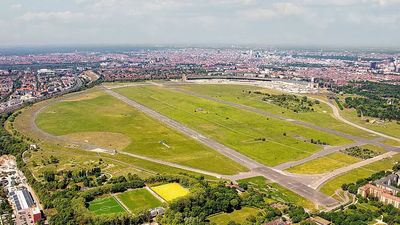
Overview
Tempelhof was one of Berlin's principal airports, housed in a monumental terminal building that was among the largest structures in the world when built; it is now a decommissioned airfield whose grounds serve as a vast public park. It is located in the Tempelhof-Schöneberg district of central-southern Berlin.
History
The site's aviation use dates to the early 20th century, and it became a designated airport in 1923. The vast curved terminal that defines the site today was constructed between 1936 and 1941 under the Nazi regime as part of Albert Speer's plans to remake Berlin as "Germania." Designed by Ernst Sagebiel, its more-than-kilometer-long arc and cantilevered hangar roof were intended as a monument to Nazi power; the building was never fully completed before the war halted construction. During the Nazi era portions of the complex were used for forced labor and aircraft assembly.
Tempelhof's defining historical moment came in 1948–49 during the Berlin Blockade, when the Soviet Union cut off land access to West Berlin. It became the primary landing site for the Berlin Airlift, with Allied aircraft delivering food, coal, and supplies to the isolated western sectors—at peak, planes landed roughly every few minutes. The airlift became a central symbol of the early Cold War and Western resolve, and Tempelhof's role cemented its place in Berlin's postwar identity.
The airport continued operating through the Cold War and beyond, serving as a U.S. Air Force base and later a commercial airport. It closed to air traffic in 2008 amid consolidation to Schönefeld and the new Brandenburg airport. In 2010 the airfield opened as Tempelhofer Feld, a large public park; a 2014 referendum blocked development and preserved the open space. The terminal building has since been used for events, exhibitions, and as emergency refugee accommodation.
Olympiastadion

Overview
Olympiastadion is a large stadium built for the 1936 Summer Olympics, now used primarily for football and major events; it is the home ground of Hertha BSC. It is located in the Westend area of Berlin's Charlottenburg-Wilmersdorf district, in the western part of the city.
History
The stadium was constructed between 1934 and 1936 for the 1936 Berlin Olympics, replacing an earlier stadium on the same site (the Deutsches Stadion). Designed by Werner March, it was built as a showcase for the Nazi regime, which used the Games as an international propaganda platform. The 1936 Olympics are best remembered for African American athlete Jesse Owens winning four gold medals, undercutting Nazi claims of Aryan supremacy on the regime's own stage. The surrounding Reichssportfeld complex was designed to project monumental Nazi aesthetics.
The stadium survived World War II largely intact, unusual among major Berlin structures. During the Cold War it fell within the British sector of West Berlin, and the British military administration used the surrounding grounds for its headquarters. The stadium hosted football and events throughout the postwar decades, becoming the home of Hertha BSC.
Between 2000 and 2004 the stadium underwent a major reconstruction, adding a partial roof and modernizing facilities while preserving its historic stone structure. It hosted the 2006 FIFA World Cup final and the 2015 UEFA Champions League final, and served as a venue for UEFA Euro 2024, including the final. It also hosts the annual DFB-Pokal (German Cup) final and major athletics and concert events.