Walking Tour
Overview
The sites we will see Monday are all within walking distance in central Berlin (Mitte), and together they trace the arc from Prussian imperial ambition through Nazi terror to Cold War division and reunification. Expect the day to move between grand ceremonial architecture and stark memorials to atrocity, often on the same block. Most sites are outdoors and free to view; wear comfortable shoes and budget time for the reflective weight of the Holocaust Memorial and Wall sites in particular.
Brandenburg Gate
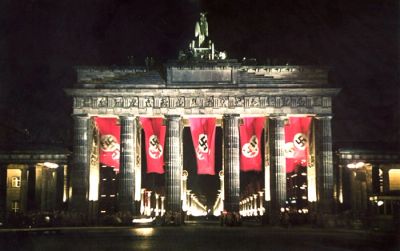
Berlin's defining landmark, a neoclassical triumphal arch built 1788–1791 under Frederick William II and modeled on the Propylaea of the Athenian Acropolis, crowned by the Quadriga (Victory driving a four-horse chariot). Napoleon looted the Quadriga in 1806 and it was returned in 1814. Under the Nazis it served as a backdrop for torchlit parades; after WWII it stood stranded in the death strip beside the Wall, becoming the symbol of a divided city and then, at the 1989 fall and 1990 reunification celebrations, of renewed unity.
Reichstag
The seat of the German parliament (Bundestag), opened in 1894 to house the Imperial Diet. The 1933 Reichstag fire gave the Nazis a pretext to suspend civil liberties and consolidate power; the building was gutted in the 1945 Battle of Berlin, where a Soviet soldier's flag-raising became an iconic image. Left a ruin through the Cold War, it was reconstructed after reunification by Norman Foster, whose glass dome (1999) symbolizes governmental transparency and offers a free panoramic view—advance registration required.
Holocaust Memorial
Formally the Memorial to the Murdered Jews of Europe, designed by Peter Eisenman and opened in 2005. It consists of 2,711 gray concrete stelae of varying heights arranged in a grid on undulating ground, producing a disorienting, isolating effect as you walk deeper into it. Eisenman offered no fixed interpretation. Beneath sits an underground Information Centre documenting individual victims and families, grounding the abstract field above in personal loss.
Führerbunker
The subterranean complex where Hitler spent his final weeks and died by suicide on 30 April 1945 as Soviet forces closed in. The bunker lay beneath the Reich Chancellery garden; the East Germans partially demolished it, and the site was deliberately left unmarked for decades to prevent it becoming a neo-Nazi shrine. Today it is an ordinary parking lot for an apartment block, marked only by a modest information board installed in 2006 explaining the layout and history.
Berlin Wall Memorial
The main memorial to the Wall, running along Bernauer Strasse, where the border cut directly between buildings and people once leapt from windows to escape west. It preserves the last intact section of the full border installation—including the "death strip," watchtower, and guard path—alongside a documentation center, the Window of Remembrance for those killed attempting to cross, and the Chapel of Reconciliation. It is the most complete and sobering account of how the Wall (1961–1989) functioned and what it cost.
Checkpoint Charlie
The best-known Cold War crossing point between the American and Soviet sectors, and the only one foreigners could use. In October 1961 it was the site of a tense US–Soviet tank standoff. Today the original checkpoint is gone, replaced by a reconstructed guard booth, a sign reading "You are leaving the American sector," and a heavily touristed, somewhat commercialized scene with costumed actors; the nearby Mauermuseum documents escape attempts, though the spot itself is more symbol than substance.
Gendarmenmarkt
Widely regarded as Berlin's most beautiful square, laid out in the late 17th century and framed by three monuments: the Konzerthaus (concert hall) at center, flanked by the near-identical German Cathedral and French Cathedral—the latter built for Huguenot refugees who shaped early Berlin. Heavily damaged in WWII and painstakingly restored, it now hosts concerts and, in winter, a noted Christmas market. Your hotel sits on this square, so it functions as a natural anchor for the day.
Bebelplatz
square on Unter den Linden, framed by the State Opera and the old royal library, and infamous as the main site of the 10 May 1933 Nazi book burnings, when students torched some 20,000 works by Jewish, leftist, and other "un-German" authors. Micha Ullman's understated memorial, "The Empty Library," is set into the pavement: a window into a white subterranean room of empty shelves. A nearby plaque carries Heinrich Heine's 1820 line—"Where they burn books, they will in the end also burn people"—chillingly prophetic of the Holocaust.