WWII & Cold War
Introduction
Berlin is unusual among capitals in that it doesn't sequester its worst history behind velvet ropes — it leaves it in the street. This cluster traces three overlapping layers: the machinery of the Nazi state (the Gestapo/SS command sites), the internal resistance that tried to stop it (the July 20 plotters, executed a few hundred meters from where they schemed), and the Cold War division that turned the defeated city into the front line of a second, colder war. What ties these sites together isn't spectacle but proximity to decision — the desks, courtyards, prisons, and walls where power was exercised and contested. Expect documentation over monumentality; the emotional weight comes from standing on the actual ground, not from anything built to move you
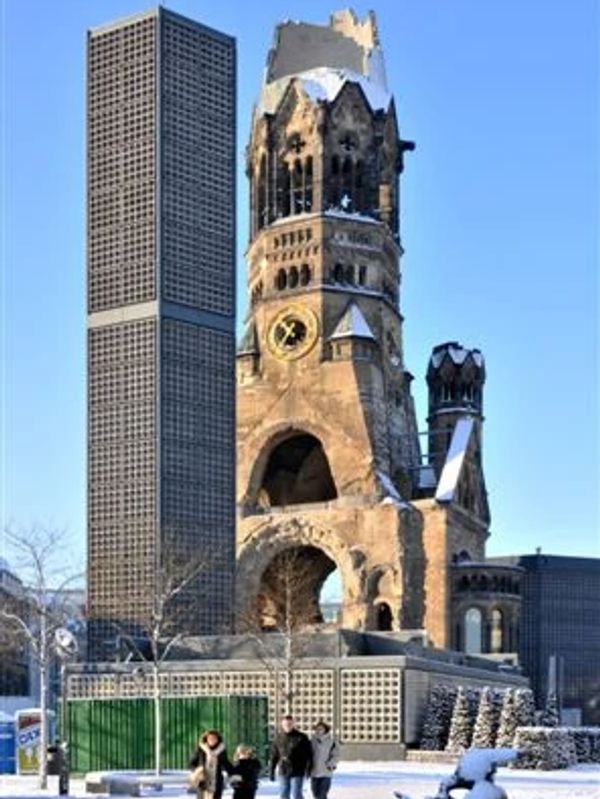
Kaiser Wilhelm Memorial Church
A neo-Romanesque church left as a bomb-shattered ruin after 1943, its broken spire preserved deliberately as an anti-war statement. A modern octagon of blue stained glass sits alongside it, so the ruin and its answer stand in a single frame

Topography of Terror
A documentation center built on the excavated grounds of the Gestapo and SS headquarters, the nerve center of Nazi state terror. Indoor and open-air exhibitions trace the security apparatus and its victims, running alongside one of the longest preserved stretches of the Wall. Free, and among the most substantive history sites in the city
.jpeg/:/rs=w:1209,h:605,cg:true,m/cr=w:1209,h:605)
East Side Gallery
The longest surviving continuous segment of the Berlin Wall, 1.3 km along the Spree, painted by artists from around the world in 1990. It functions as both memorial and open-air gallery, with images like the Brezhnev-Honecker kiss now globally recognized. Sits in Friedrichshain, so it pairs with that district
.jpeg/:/rs=w:1209,h:605,cg:true,m/cr=w:1209,h:605)
German Resistance Memorial Center (Bendlerblock)
The former army headquarters where Stauffenberg and fellow officers planned the July 20, 1944 attempt on Hitler's life. When the plot failed, the ringleaders were shot the same night in the courtyard, which is now a memorial. The permanent exhibition documents the broader German resistance. Near the Kulturforum

Hohenschönhausen
The Stasi's main remand prison, where the GDR held and interrogated political prisoners under psychological duress. Tours are led by former inmates, which makes it the most visceral Cold War site in Berlin. Far northeast, and worth the trek if the subject grips you

Stasi Museum (Lichtenberg)
The preserved headquarters of the GDR Ministry for State Security, including minister Erich Mielke's original offices. Exhibits cover surveillance methods, informant networks, and the machinery of a police state. Lighter and less harrowing than Hohenschönhausen; pick one if time is short
.jpeg/:/rs=w:1209,h:605,cg:true,m/cr=w:1209,h:605)
German-Russian Museum Karlshorst
The building where the Wehrmacht signed its unconditional surrender to the Soviets late on May 8, 1945, ending the war in Europe. The surrender hall is preserved, surrounded by exhibits on the German-Soviet war. Far out; skip unless the surrender itself draws you
Street & Youth Culture
Introduction
When the Wall fell, East Berlin emptied — factories shuttered, buildings stood ownerless, rent collapsed to nothing. Artists, squatters, and clubbers moved into the vacuum, and that improvised occupation of abandoned space became the city's defining postwar identity. Layered on top is the older immigrant Berlin of the former West — Turkish, Kurdish, Arab Kreuzberg and Neukölln — whose markets and food long predate the hipster wave and still anchor it. These aren't sights so much as districts to move slowly through: graffiti-caked railyards, canal-side markets, rooftop bars on parking garages, flea markets in former death-strip parkland. Come hungry, wear shoes you'll walk in, and don't over-schedule — the point is drift

Friedrichshain
The former East's youth-culture heartland, centered on the RAW-Gelände, a derelict railway-maintenance yard turned club, graffiti, and skate complex. Boxhagener Platz and Simon-Dach-Straße add cafés, a weekend flea market, and bar-lined streets. Anchors naturally with the East Side Gallery

Kreuzberg Food & Street
The historic core of Turkish and immigrant Berlin, and later its punk and squatter scene, now among the densest food-and-nightlife districts. Markthalle Neun runs a celebrated Street Food Thursday, and the Maybachufer Turkish Market lines the canal on Tuesdays and Fridays. Bergmannkiez and Oranienstraße carry the daytime browsing and evening bars
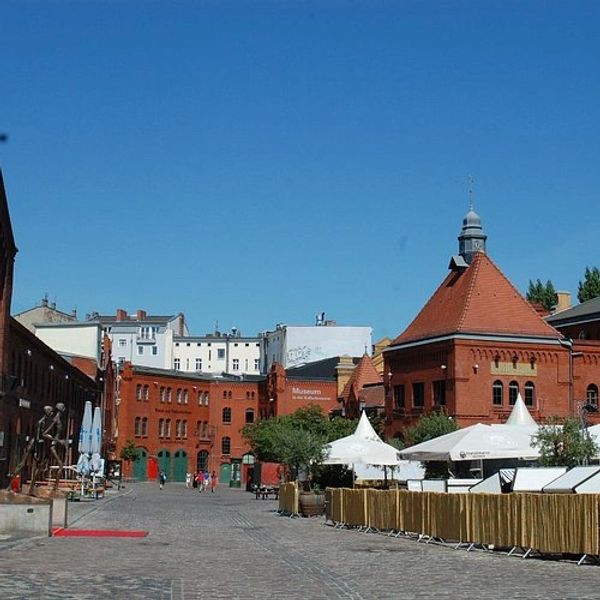
Prenzlauer Berg & Mauerpark
A GDR-era district now thoroughly gentrified into a family-friendly quarter of restored tenements and leafy squares. Mauerpark, built on former death-strip land, hosts a large Sunday flea market and the open-air Bearpit karaoke, both Sundays only. Kollwitzplatz and Kastanienallee handle the café-and-boutique strolling
Neukölln
The grittier, younger counterweight, long immigrant and now heavily creative, with the Weserstraße bar corridor at its center. Klunkerkranich, a bar and garden on a parking-garage roof, delivers the best casual sunset view in the district. Thin on daytime sights; come in the late afternoon or evening
Architecture: Prussian Grandeur & Monumental Modernism
Introduction
Berlin's skyline is an argument between competing visions of power, and every regime that ruled here built to refute the last. Hohenzollern kings and their architect Schinkel laid down a neoclassical imperial capital — Museum Island, Unter den Linden, Charlottenburg — meant to place Prussia among the ancients. Then the twentieth century answered with its own monumentality: Mies van der Rohe's glass temple and Scharoun's asymmetric concert hall at the Kulturforum; the GDR's socialist gigantism at the Fernsehturm and Karl-Marx-Allee; and, after reunification, the corporate spectacle of Potsdamer Platz. Reading these against each other — grandeur meant to dignify versus modernism meant to declare a new order — is the actual pleasure here, and the sites cluster tightly enough in Mitte and at the Kulturforum to make the contrast walkable
Charlottenburg Palace
The largest surviving Hohenzollern palace, a Baroque complex begun in the 1690s for Sophie Charlotte and expanded across the eighteenth century. The state apartments, Rococo interiors, and formal gardens survive despite heavy war damage and reconstruction. The fullest surviving statement of Prussian royal ambition in the city
Museum Island
A UNESCO ensemble of five state museums on a Spree island, built across the nineteenth century to house Prussia's imperial collections. The Berliner Dom and Schinkel's Altes Museum define its monumental face; the Neues Museum and Bode round it out. Note that the Pergamon's main hall is closed for renovation through roughly 2027
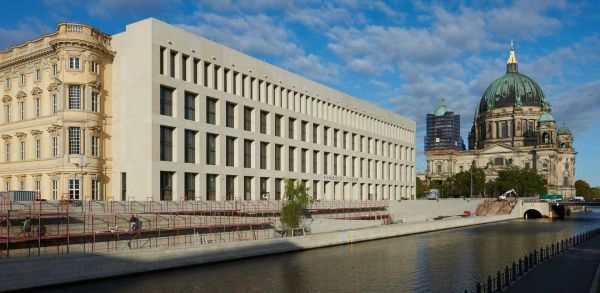
Humboldt Forum / Berliner Schloss
A reconstruction of the demolished Hohenzollern city palace, its Baroque façade rebuilt over a wholly modern museum interior. The building itself stages the grandeur-versus-modernism tension the rubric is about, and the reconstruction remains contested. Houses ethnological collections and Berlin-history exhibits
Unter den Linden corridor
The ceremonial boulevard of imperial Berlin, lined with Schinkel and Prussian state architecture. The Neue Wache (Schinkel, now holding Kollwitz's Pietà), the Zeughaus (German Historical Museum), and the Staatsoper anchor the walk. Best experienced on foot as a single sequence
Neue Nationalgalerie
Mies van der Rohe's last completed building, a steel-and-glass temple of modernism opened in 1968 and restored by David Chipperfield, reopening in 2021. The vast column-free glass hall over a sunken gallery is the point, as much as the twentieth-century art inside. The keystone of the Kulturforum
Berliner Philharmonie
Hans Scharoun's 1963 concert hall, whose asymmetric tent-like form and vineyard-terraced seating rewrote how concert halls are built. The exterior and lobby reward a visit even without a performance. Sits directly beside the Neue Nationalgalerie
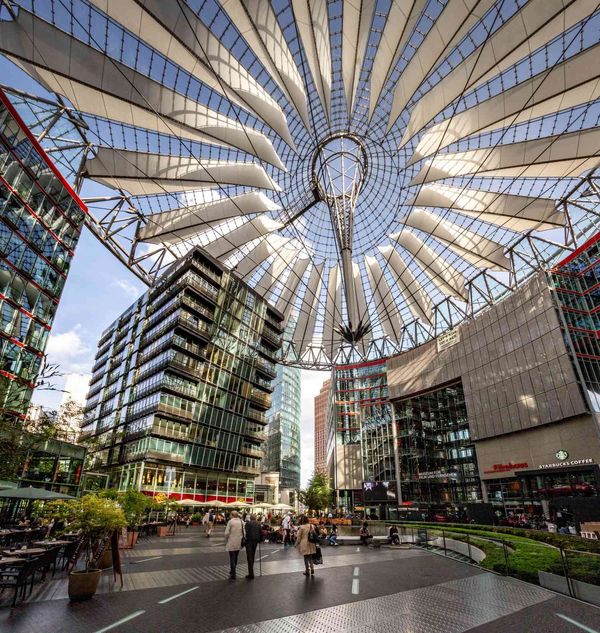
Potsdamer Platz
A prewar traffic hub reduced to death-strip wasteland by the Wall, then rebuilt in the 1990s as a showcase of post-reunification corporate architecture. Helmut Jahn's tented Sony Center and the brick Kollhoff Tower are the signatures. A compressed lesson in how the reunified city chose to present itself
Fernsehturm, Alexanderplatz
The GDR's television tower, completed in 1969 and still the tallest structure in Germany at 368 m. Built as a socialist statement of technological confidence, it now dominates the skyline as the city's most recognizable landmark. The monumental-modernist counterweight to Prussian Berlin
Karl-Marx-Allee
A monumental GDR boulevard of the 1950s, lined with Stalinist "wedding-cake" apartment blocks clad in ceramic tile. Built as socialist workers' housing and a parade route, it's the fullest expression of East German architectural ambition. Runs into Friedrichshain, so it pairs with that district